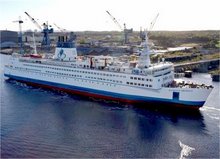
I've gotten some emails asking for more information about Mercy Ships so I thought I would give some more information about this organization. It is definitely an organization I am proud to be a part of and would highly recommend it to anyone looking to get involved in mission work.
Mercy Ships is a non-profit organization whose purpose is to bring hope and healing to the forgotten poor using Jesus as its example: the blind see, the lame walk, the mute speak and the Good News is proclaimed and demonstrated. For those of you who read my blog regularly, you know about the hospital - where surgeries are performed everyday to restore sight, repair orthopedic problems, restore dignity to women leaking urine, remove facial tumors and restore function to burn victims. This is a large part of what Mercy Ships does but it's not all.
One of the problems with many NGOs (non-governmental organizations) is that they come into countries like Liberia that are in desperate need of support (and I'm sure with good intentions) but cause long-term stability problems. If an NGO comes in and gives handouts but doesn't create programs that are viable once the NGO leaves, then they have not really helped all that much. For example, if an NGO comes to Liberia and distributes rice for free, it is definitely welcomed during the emergency phase when people are starving. However, if they continue to distribute rice for free for years on end without establishing any programs to help people find ways to provide food for themselves, then what happens when that NGO leaves? People again are starving and have no means to feed themselves.
Mercy Ships is different than these other types of NGOs. The hospital part of Mercy Ships is definitely a unique program that really only impacts the individual who is having surgery. It doesn't necessarily have an impact on the nation as a whole. But the hospital is only one ministry that Mercy Ships offers.
Mercy Ships partners with local organizations (usually churches) in the country where we are working that already have visions and goals. We don't come in to start programs on our own - we only help local organizations that are already working to make a difference. So when Mercy Ships leaves the country, the program doesn't just fall apart.
For example, a Mercy Ships team helped build a new medical clinic. This clinic was the vision of a local church. The church had saved enough money to purchase some land and was planning on building a house for their pastor. However, the church/pastor decided that the community needed a medical clinic more than the pastor needed a house. So they decided to use the land for the clinic instead. They were in the process of making the cement blocks for the new clinic when Mercy Ships came alongside them and helped to build the clinic. It is staffed by local doctors/nurses and just opened in September. It is the only clinic available to serve this community of 50,000 people. This clinic is not dependent upon Mercy Ships for funds or volunteers. It is self-sufficient and when we leave in November it will not be affected.
Here are other programs that Mercy Ships has going on in addition to surgeries while we are here:
Womens empowerment - teaches women how to create and operate two businesses: how to raise rabbits (to sell) and how to raise bees (to sell the honey).
Agriculture - teaches farming techniques (including to prisoners so they will have a skill when they get out).
Community Health Education- works with a village to reduce health problems caused by lack of hygiene, latrines, clean water, etc.
HIV/AIDS - challenges pastors to form groups and lead the campaign to address this issue.
Mental health - developing programs at the request of the Liberian govt to address the mental health issues caused by the trauma of war.
Church empowerment - assists to bring churches together to make a difference in their community. Is sponsoring an upcoming pastor's conference that over 450 pastors will attend.
Schools - a new school in Congo Town was built. The community had already laid the foundation of the school when Mercy Ships came alongside them to help finish the project.
Dental Clinic - operates daily out of Redemption Hospital to provide free dental work. In addition, they travel to the prison to also perform free dental work.
Mercy Ministries - provides opportunities for the crew to volunteer at Sisters of Charity (the organization created by Mother Teresa), two orphanages, a home for the disabled, the mens and womens prisons and the pediatric hospital.
Mercy Ships also has a land based operation in Sierra Leone where they have a permanent clinic that performs free VVF surgeries (the leaking urine problem) as well as the New Steps rehab clinic providing rehabilitation services to physically disabled people (1 out of 10 people are disabled in Sierra Leone because of the civil war).
Mercy Ships also has a land based operation in Honduras called Global Missions Health Institute. It's an educational and empowerment program that assists medical professionals and community health workers to design programs for sustainable health care improvements in the communities in which they live.
As you can see, Mercy Ships is more than just a hospital ship and we are always looking for volunteers. Any skill that you possess can be utilized by Mercy Ships. The medical staff is a small part of this organization. In addition, we have accountants and hairdressers here; chefs and kitchen staff; housekeepers and hospitality crew; engineers, electricians, plumbers, deckhands, security and maritime officers (and many other ship-type positions that I've never heard of like bosuns)...it takes a lot of people to run this big ship! You can come for as little as two weeks or for as long as the rest of your life (if you come forever, you get a better cabin:).
So there's my plug for this great organization. You can check out their website at http://www.mercyships.org/.
Peace,
Michele
Saturday, October 13, 2007

Wednesday, October 10, 2007
Palliative Care
Ok, so it's a two post night. This post is in response to Tyronebcookin who asked that I give more specifics about the palliative care program on Mercy Ships so here it is. Thanks for asking, Tyrone!
The PC program became an official program this outreach. In years past, Mercy Ships has done PC but never had a budget or anything. The PC team is made up of two nurses (Jean and me), one translator, and then we have 4 crew members who go out with us when their schedules permit.
From a nursing perspective, PC is like home health care rather than hospice care back home (at least in the States). We have patients that are referred to us that need some sort of ongoing support because they have a condition that we can't help with on the ship. Most of the time they have a terminal condition but not always. We go to their homes and do wound care, provide pain medications, do lots of teaching. We also provide emotional and spiritual support - this includes praying, reading Scripture, doing Bible studies. We've tried support groups but Liberians don't talk about death or feelings or anything that makes a support group work. After a patient dies, we continue to visit the family to give them support.
Most of our patients have cancer and most of them are children, although we received 3 new patients this week who are all adults. We work M-F from about 7:30 - 5:00. We don't have a car on the weekends so we can't do any weekend visits.
We get our patients, usually through screenings done by the ship (dental, maxillo-facial, eye). People come to the ship for help and when we see it is something that is malignant or something we don't have the expertise for, they get referred to PC. We've gotten a couple of patients just walking in the market. We don't have a big enough budget or enough PC staff to seek out patients in the community.
It's a great job but emotionally and spiritually demanding. I'll be taking over the PC program in Sierra Leone since my partner Jean is leaving in January. We, hopefully, will be getting another nurse to replace Jean but it really needs to be someone who will be staying the majority of the outreach in Sierra Leone (until Nov).
Tyrone, if you or your wife have more questions, please feel free to email me at mzeller27@yahoo.com.
Peace,
Michele
The PC program became an official program this outreach. In years past, Mercy Ships has done PC but never had a budget or anything. The PC team is made up of two nurses (Jean and me), one translator, and then we have 4 crew members who go out with us when their schedules permit.
From a nursing perspective, PC is like home health care rather than hospice care back home (at least in the States). We have patients that are referred to us that need some sort of ongoing support because they have a condition that we can't help with on the ship. Most of the time they have a terminal condition but not always. We go to their homes and do wound care, provide pain medications, do lots of teaching. We also provide emotional and spiritual support - this includes praying, reading Scripture, doing Bible studies. We've tried support groups but Liberians don't talk about death or feelings or anything that makes a support group work. After a patient dies, we continue to visit the family to give them support.
Most of our patients have cancer and most of them are children, although we received 3 new patients this week who are all adults. We work M-F from about 7:30 - 5:00. We don't have a car on the weekends so we can't do any weekend visits.
We get our patients, usually through screenings done by the ship (dental, maxillo-facial, eye). People come to the ship for help and when we see it is something that is malignant or something we don't have the expertise for, they get referred to PC. We've gotten a couple of patients just walking in the market. We don't have a big enough budget or enough PC staff to seek out patients in the community.
It's a great job but emotionally and spiritually demanding. I'll be taking over the PC program in Sierra Leone since my partner Jean is leaving in January. We, hopefully, will be getting another nurse to replace Jean but it really needs to be someone who will be staying the majority of the outreach in Sierra Leone (until Nov).
Tyrone, if you or your wife have more questions, please feel free to email me at mzeller27@yahoo.com.
Peace,
Michele
Nush and Joanna
My beautiful little patient Nush died Monday night unexpectedly. I've talked a little bit about him in the past. He was the one we gave money to last week so that he could go to school for the first time ever and he was soooo excited about it. Nush turned 8 on Sunday.
Monday afternoon, we had planned to visit him to give him his birthday presents. I got him a football and Jean got him some Matchbox cars and some school supplies. Because we have to be back on the ship by 5 pm to turn in our car, we ran out of time and couldn't see him. So our plan was to visit him first on Tuesday morning to give him the presents. On our way out of the ship, Nush's uncle Jeremiah called and told us Nush had died last night. He just started vomiting so they took him to the clinic and he died. Just like that...no warning or decline in health.
It was a devastating call. Even though Nush had cancer, he was getting chemo and seemed to be so healthy. I never expected him to die so it's been a shock - and especially so to his family. Right after the call, we went to Nush's house. There were so many people, crying. I've described their mourning process in a previous post (see post from Sept. 21) so I won't go into again but it was the same as the last time.
We took Nush's body to the gravesite in our Land Rover. If we hadn't been there, they would have had to take him in a taxi. The men in the family had been digging his grave all morning. It was an area out in the woods - it was a beautiful area but it's very strange to my Western thinking about cemetaries. The father said a few words and then they asked us to say a few words. Jean read Psalm 23 and then talked about Nush and his life. Thankfully, this has happened to Jean before where she was expected to be the preacher at a funeral so she was prepared and said some really meaningful things, in my opinion.


Everyday something happens here that makes me think about God's sovereignty vs. human suffering. Everyday we are approached multiple times asking for help for some health problem - yesterday it was a little 5 year old girl whose head was tilted sideways and stuck in this position; the day before it was a little 4 year old boy whose legs were both bent to the left; sometimes it's people missing limbs; one time it was someone who had travelled three days to get to Mercy Ships for an orthopedic problem but came across us before they got to the ship. And everyday, several times a day, I have to say I'm sorry, we can't help you. Most of these problems are not things we can fix on the ship and even if they were, our surgery schedule is full for the remainder of the outreach in Liberia. It's absolutely heartbreaking to say 'we can't help you' when Mercy Ships is their final hope for healing through human means.
I have no answers to the questions about why a sovereign God 'allows' suffering. I just know that, even without answers, my faith is growing stronger everyday. There is no way I could do this job if I didn't believe in an eternal hope. I heard several times at the funeral yesterday that Nush's death was God's will. I absolutely do not believe the death of an innocent little boy was God's will. Death was never God's will (read Genesis if you don't believe it). And then read about the crucifixion and resurrection of Jesus Christ to see how God overcame death. If death was God's will, why would He send Jesus?
I'm going to end on a high note. Baby Joanna (posts from Sept 28 and Oct 7) went home Monday and we stopped by to see how they were doing. Joanna and her mother Rebecca weren't home but were at church down the street. Let me tell you, this is a huge deal. Until this week, Rebecca had NEVER been able to take Joanna out in public because of their belief she is cursed. Joanna's uncle and grandpa were just beaming and saying they were so happy about Joanna's new face and thanking us profusely...another humbling moment since we were so close to losing her.
Peace,
Monday afternoon, we had planned to visit him to give him his birthday presents. I got him a football and Jean got him some Matchbox cars and some school supplies. Because we have to be back on the ship by 5 pm to turn in our car, we ran out of time and couldn't see him. So our plan was to visit him first on Tuesday morning to give him the presents. On our way out of the ship, Nush's uncle Jeremiah called and told us Nush had died last night. He just started vomiting so they took him to the clinic and he died. Just like that...no warning or decline in health.
It was a devastating call. Even though Nush had cancer, he was getting chemo and seemed to be so healthy. I never expected him to die so it's been a shock - and especially so to his family. Right after the call, we went to Nush's house. There were so many people, crying. I've described their mourning process in a previous post (see post from Sept. 21) so I won't go into again but it was the same as the last time.
We took Nush's body to the gravesite in our Land Rover. If we hadn't been there, they would have had to take him in a taxi. The men in the family had been digging his grave all morning. It was an area out in the woods - it was a beautiful area but it's very strange to my Western thinking about cemetaries. The father said a few words and then they asked us to say a few words. Jean read Psalm 23 and then talked about Nush and his life. Thankfully, this has happened to Jean before where she was expected to be the preacher at a funeral so she was prepared and said some really meaningful things, in my opinion.
Nush had the biggest smile and really cute dimples. Plus he was really outgoing. When we drove him to the hospital, he was a backseat driver and always pretended he was driving and also kept giving Jean directions on what to do. He liked to dance and I'm really sorry I didn't take a video of him dancing. Last time I saw him, he was doing this hilarious dance but I thought that I would have him do it again the next time so I could video him. You never know that there isn't going to be a next time.
We brought him to the ship about a week and a half ago for some fun times. Here are some photos I took. Here he is showing off his play-doh jewelry and getting his feet painted. We put paint on their hands and feet and then pressed them on to paper.


Here he is with his adorable younger sister Jessica.
Please pray for Nush's mother, Aretha. She wasn't doing too well yesterday.
We stopped by their house today to see how she was and drop off some rice but she was at her parent's house.
We stopped by their house today to see how she was and drop off some rice but she was at her parent's house.
Everyday something happens here that makes me think about God's sovereignty vs. human suffering. Everyday we are approached multiple times asking for help for some health problem - yesterday it was a little 5 year old girl whose head was tilted sideways and stuck in this position; the day before it was a little 4 year old boy whose legs were both bent to the left; sometimes it's people missing limbs; one time it was someone who had travelled three days to get to Mercy Ships for an orthopedic problem but came across us before they got to the ship. And everyday, several times a day, I have to say I'm sorry, we can't help you. Most of these problems are not things we can fix on the ship and even if they were, our surgery schedule is full for the remainder of the outreach in Liberia. It's absolutely heartbreaking to say 'we can't help you' when Mercy Ships is their final hope for healing through human means.
I have no answers to the questions about why a sovereign God 'allows' suffering. I just know that, even without answers, my faith is growing stronger everyday. There is no way I could do this job if I didn't believe in an eternal hope. I heard several times at the funeral yesterday that Nush's death was God's will. I absolutely do not believe the death of an innocent little boy was God's will. Death was never God's will (read Genesis if you don't believe it). And then read about the crucifixion and resurrection of Jesus Christ to see how God overcame death. If death was God's will, why would He send Jesus?
I'm going to end on a high note. Baby Joanna (posts from Sept 28 and Oct 7) went home Monday and we stopped by to see how they were doing. Joanna and her mother Rebecca weren't home but were at church down the street. Let me tell you, this is a huge deal. Until this week, Rebecca had NEVER been able to take Joanna out in public because of their belief she is cursed. Joanna's uncle and grandpa were just beaming and saying they were so happy about Joanna's new face and thanking us profusely...another humbling moment since we were so close to losing her.
Peace,
Michele
Monday, October 8, 2007
Ups and Downs
I've found that every day in palliative care is different and it's never all a good day or all a bad day. It's always both. We may do one visit where everyone is happy and then the next family we visit is grieving. Emotionally it's up and down, up and down. Today was like that.

We had two new patients referred to us last week so we visited them both today. The first visit is never good and I don't look forward to them. Our first visit of the morning was to Mary. She is a 24 year old with retinoblastoma (a cancer in the eye). She is from another county on the border of Cote D'Ivoire far from Monrovia and had come with her uncle and mother seeking treatment. She has been here five months and away from her two children who are 9 and 6.
Driving out to where she is staying was a new experience for me as it was out in the countryside. Liberia is actually a very beautiful country once you get out of the congestion and poverty of the city. There are mountains, lots of green trees (they call it the bush - we call it woods) - coming over the top of a hill and looking out over miles of green and mountains was amazing to witness. So far I had only experienced the congestion of a city of 1.5 million people.
We arrived at the village where Mary was staying and it was lots of mud and stick houses, big shade trees and, of course, lots of kids. We spent about an hour with her and her family and it was really hard. We are always the ones who have to tell them that there is no treatment for what they have and that the disease will worsen until their body gives up. There were a lot of tears from Mary and her mother.

They will be leaving on Friday to return home so we will visit again on Wednesday to bring more pain medicine and dressings for her wound. We also took a family photo so they will have a remembrance of Mary. I don't think she has long to live - she is stick thin and has pain throughout her body so it's probably metastized to other areas from the eye. Here is a photo of Mary with her mother and her two uncles.
I've posted before about this culture and their grieving process. Today I noticed something else. Whenever anyone cries, the men always tell them in harsh words to stop crying. I don't know why they do this. God made our tears for a purpose. Fortunately, no one listened to them.
We left the family and made our way to the next person who is also new. Her name is Martha and her husband met us to show us the way to the house. It was also a new area of Monrovia that I hadn't seen. We had to park a little ways from the house and then hike over a small, rocky path. Here is the view from the path.
 rocky path. Here is the view from the path.


This last photo shows the ocean in the background as well as a large burned out building that used to be the Defense Ministry building. It's a sad reminder of the war. You can also see in the forefront of this picture the framing of a new house being built. Unfortunately, all of the people who live in this area are squatters (they don't own the land - they just put up a house on someone elses land). Our translator told us the government eventually would kick all of these people out of their houses and tear down the buildings.
We made it to Martha's house and it was a deja vu from our visit to Mary. We had the same words to say - there is no treatment and your body will eventually give up. Martha was there with her husband and three of her sisters. Again, there were lots of tears from the women. And again harsh words from the men to stop crying. At times, it was a surreal experience. While these women were wailing, one of the sisters pulled a live chicken out of a sack she had been holding (because it kept squawking) and just held it by it's legs while she cried. I'm glad she did since the chicken moving excitedly around inside the sack was really distracting.
Martha has two children who are 19 and 13. They sent the 13 year old boy away to a mission school because he would cry when he saw his mom's wound on her face. When we were ready to leave, Martha asked us if we would take her children and care for them when she was gone. It was heartbreaking to say no (Jean said it, I didn't).
We didn't offer to take a family photo - Martha has a big, open gaping wound and a pretty distorted face from the tumor growing. I'm not sure if we will offer in the future when there isn't so much crying.
Our last two visits of the day were the good parts. We spent our usual time with Candy who continues to feel fine although she has lost quite a bit of weight. We have finally figured out a pain medication protocol that works so her wound care isn't very painful. She was smiling today.
We ended with a quick stop at Gracie's house. I haven't talked about her before, I don't think. She is 13 years old and has lots of growths around her neck and face. She was referred to palliative care many months ago because the doctors believed what she had was malignant. We finally had a biopsy done on her last week and, great news, it's not cancer...it's TB. I only thought TB manifested itself in the lungs but it can actually attack any area of the body. In her case, it looks like small tumors. And the even better news is that TB can actually be treated here in Liberia!
So we will be taking her to the TB clinic tomorrow to get her started on the medication - she will have to take it everyday at the same time for at least six months. I'm hoping the growths start to reduce right away so she doesn't have to wear her scarf around her head and neck everyday. Here's a photo of Gracie - she is beautiful!
The day ended with another going away party. Last night we had a going away party for my roommate Joy who left today. Tonight we had a going away party for my friend Gea who is leaving Wednesday. Thursday we will have a going away party for my roommate Amber who leaves Friday. There are an unbelievable number of good-byes in both my job and on the ship.
Peace,
Michele
Sunday, October 7, 2007
Emergencies on board
We have emergency crews on board for many different possible situations. We have a fire crew to take care of fires (we've had one since I've been here) and we also have fire drills about every two weeks to make sure we all know what to do. Fires onboard aren't good especially if you are out to sea. The fire we had last week was a small electrical one and no one had to leave the ship. But it's a scary thing when the PA system calls for the fire team.
We also have an emergency medical team that consists of doctors, nurses, stretcher bearers, chaplains and the captain. This alarm, unfortunately, has gone off more times in the last 3 1/2 months than it ever went off in the previous few years I'm told. The first time I heard this alarm was on July 29 when one of our crew drowned far from the ship. Our team went to see how we could help. Sadly, it was far too late when the team arrived. Ever since that day, the sound of the emergency medical team alarm makes me sick.
Since then, it has alarmed at least 8 times, usually because of patients on the ward and several times in the middle of the night - it is a horrible sound. Twice it has gone off due to the fact that someone has brought a very sick person to the dock - we aren't an ER but apparently people think we can help better than the local hospital. Both times we have been able to stabilize the patient and send them home.
The last alarm was at 10:40 on Tuesday evening. The alarm came on saying 'Emergency medical team report to Hope ward' and then it repeated three more times. Since I don't work on the ward anymore, I don't know the patients so usually I wouldn't be worried that it is one of my patients. However, this time was different - baby Joanna was on Hope ward (see post from Sept. 28 if you don't know who I'm talking about).
My roommate Amber (an ICU nurse) and I hopped out of bed, got dressed and rushed down to Hope ward. On the way, we stopped in ICU as they were preparing a bed and I asked what was going on. Someone said a one year old had stopped breathing. I was slightly relieved from the fact that Joanna was 6 months old so it couldn't be her. So I asked 'what bed?' and they said 21. My heart stopped - that was Joanna's bed.
I continued on down to Hope ward to find about 15 doctors and nurses around Joanna's bed. All the patients from that side of Hope ward, including Rebecca her mother, had been moved out to the other side. I stood outside in the hallway and watched the action and finally one of the nurses came out and I asked what happened. She said Joanna was in cardiac arrest (her heart stopped) and respiratory arrest (not breathing). She had a flat line on the heart monitor which means that you can't defibrillate (shock the heart) to restart it because there has to be some electrical activity to begin with. So they did CPR and gave drugs.
After a thousand prayers and what seemed like an hour (which was only a few minutes), I heard Joanna crying - crying hard, an angry cry. An unbelievable relief. They continued to work on Joanna to stabilize her for quite a long time. All the while, nurses would go to Rebecca to give her updates on what was happening. By this time, I was with Rebecca, along with Jean, one of our counselors and several other nurses who had come to know Rebecca.
Finally, Joanna was stabilized, intubated and on a ventilator in ICU. None of the doctors or nurses knew what had happened. It was two days after her surgery and up until the point her heart stopped, Joanna was doing well. For the next 3 days, Joanna remained in the ICU, on a ventilator and heavily sedated. We had a 24 hour pray watch for her by the crew. Clementine, our amazing discipler from Togo, spent countless hours (even sleeping in the ICU) supporting and praying for Rebecca and Joanna.
A CT scan showed some abnormalities in the brain but we will never know why she arrested. She has periodic episodes of sleep apnea (she stops breathing) and, at times, an abnormally low heart rate for a baby. Last night, they moved her to Peace ward and so now I can go and visit her.
She is doing well, is eating, breathing fine and her heart rate is usually fine. Hopefully, she will go home in the next few days. It is very likely that if she had been at home on Tuesday night, she would have died. So, while we are happy that Joanna is doing well now, we don't know what her future holds.
If this happened back home, we would spend tens of thousands of dollars on diagnostic tests so that the family could know for sure what happened and what future problems she would have. We don't have such diagnostics here so we won't know for sure what happened and we don't know for sure what Joanna's future will look like. We know her heart rate is far too low but she has lived six months with this problem. We know she has abnormalities in the ventricles of the brain as well as the cerebellum but we don't know how this will affect her (although we have some ideas).
So now I struggle with an ethical dilemma. If I was back home, we absolutely would give the patient and family all the information we have so that the family can prepare for the future. I don't know how to handle it here. Most of what we would tell her would be speculation. We are dealing with West African culture where there is no future planning even with information. Not to mention their lack of understanding of the human body (most people believe any medical issues are curses and the person with the problem should be shunned from the family so that the family will not be cursed also). So what's the purpose of telling Rebecca that Joanna may not be able to walk or perform any kind of motor skills due to her abnormal cerebellum or that Joanna's heart could stop at anytime (will Rebecca ever sleep again?). They have no apnea monitors to alarm if she stops breathing. They would have to have someone watching Joanna 24 hours a day and, even if they did, they wouldn't know how to resuscitate her.
So Jean and I will continue to support Rebecca and Joanna in the future but we really will have no answers for her. Joanna could live one more day or 50 more years (the same as any of us). My fear is that one day Rebecca will wake up and find that Joanna died in the night.
And by the way, her cleft lip is fixed. This may seem like a small thing compared to all her other medical problems but here it is very important. Because people think it is a curse, Rebecca has not been able to go out in public with Joanna. At least with her lip fixed, they can go out in public and not be seen as outcasts.
Anyways, I'm tired of emergencies and I hope to never hear that stupid emergency medical team alarm again for the rest of my life.
Peace,
Michele
We also have an emergency medical team that consists of doctors, nurses, stretcher bearers, chaplains and the captain. This alarm, unfortunately, has gone off more times in the last 3 1/2 months than it ever went off in the previous few years I'm told. The first time I heard this alarm was on July 29 when one of our crew drowned far from the ship. Our team went to see how we could help. Sadly, it was far too late when the team arrived. Ever since that day, the sound of the emergency medical team alarm makes me sick.
Since then, it has alarmed at least 8 times, usually because of patients on the ward and several times in the middle of the night - it is a horrible sound. Twice it has gone off due to the fact that someone has brought a very sick person to the dock - we aren't an ER but apparently people think we can help better than the local hospital. Both times we have been able to stabilize the patient and send them home.
The last alarm was at 10:40 on Tuesday evening. The alarm came on saying 'Emergency medical team report to Hope ward' and then it repeated three more times. Since I don't work on the ward anymore, I don't know the patients so usually I wouldn't be worried that it is one of my patients. However, this time was different - baby Joanna was on Hope ward (see post from Sept. 28 if you don't know who I'm talking about).
My roommate Amber (an ICU nurse) and I hopped out of bed, got dressed and rushed down to Hope ward. On the way, we stopped in ICU as they were preparing a bed and I asked what was going on. Someone said a one year old had stopped breathing. I was slightly relieved from the fact that Joanna was 6 months old so it couldn't be her. So I asked 'what bed?' and they said 21. My heart stopped - that was Joanna's bed.
I continued on down to Hope ward to find about 15 doctors and nurses around Joanna's bed. All the patients from that side of Hope ward, including Rebecca her mother, had been moved out to the other side. I stood outside in the hallway and watched the action and finally one of the nurses came out and I asked what happened. She said Joanna was in cardiac arrest (her heart stopped) and respiratory arrest (not breathing). She had a flat line on the heart monitor which means that you can't defibrillate (shock the heart) to restart it because there has to be some electrical activity to begin with. So they did CPR and gave drugs.
After a thousand prayers and what seemed like an hour (which was only a few minutes), I heard Joanna crying - crying hard, an angry cry. An unbelievable relief. They continued to work on Joanna to stabilize her for quite a long time. All the while, nurses would go to Rebecca to give her updates on what was happening. By this time, I was with Rebecca, along with Jean, one of our counselors and several other nurses who had come to know Rebecca.
Finally, Joanna was stabilized, intubated and on a ventilator in ICU. None of the doctors or nurses knew what had happened. It was two days after her surgery and up until the point her heart stopped, Joanna was doing well. For the next 3 days, Joanna remained in the ICU, on a ventilator and heavily sedated. We had a 24 hour pray watch for her by the crew. Clementine, our amazing discipler from Togo, spent countless hours (even sleeping in the ICU) supporting and praying for Rebecca and Joanna.
A CT scan showed some abnormalities in the brain but we will never know why she arrested. She has periodic episodes of sleep apnea (she stops breathing) and, at times, an abnormally low heart rate for a baby. Last night, they moved her to Peace ward and so now I can go and visit her.
She is doing well, is eating, breathing fine and her heart rate is usually fine. Hopefully, she will go home in the next few days. It is very likely that if she had been at home on Tuesday night, she would have died. So, while we are happy that Joanna is doing well now, we don't know what her future holds.
If this happened back home, we would spend tens of thousands of dollars on diagnostic tests so that the family could know for sure what happened and what future problems she would have. We don't have such diagnostics here so we won't know for sure what happened and we don't know for sure what Joanna's future will look like. We know her heart rate is far too low but she has lived six months with this problem. We know she has abnormalities in the ventricles of the brain as well as the cerebellum but we don't know how this will affect her (although we have some ideas).
So now I struggle with an ethical dilemma. If I was back home, we absolutely would give the patient and family all the information we have so that the family can prepare for the future. I don't know how to handle it here. Most of what we would tell her would be speculation. We are dealing with West African culture where there is no future planning even with information. Not to mention their lack of understanding of the human body (most people believe any medical issues are curses and the person with the problem should be shunned from the family so that the family will not be cursed also). So what's the purpose of telling Rebecca that Joanna may not be able to walk or perform any kind of motor skills due to her abnormal cerebellum or that Joanna's heart could stop at anytime (will Rebecca ever sleep again?). They have no apnea monitors to alarm if she stops breathing. They would have to have someone watching Joanna 24 hours a day and, even if they did, they wouldn't know how to resuscitate her.
So Jean and I will continue to support Rebecca and Joanna in the future but we really will have no answers for her. Joanna could live one more day or 50 more years (the same as any of us). My fear is that one day Rebecca will wake up and find that Joanna died in the night.
And by the way, her cleft lip is fixed. This may seem like a small thing compared to all her other medical problems but here it is very important. Because people think it is a curse, Rebecca has not been able to go out in public with Joanna. At least with her lip fixed, they can go out in public and not be seen as outcasts.
Anyways, I'm tired of emergencies and I hope to never hear that stupid emergency medical team alarm again for the rest of my life.
Peace,
Michele
Tuesday, October 2, 2007
Signs and photos
 We took our little 6 year old patient, Survivor, to St. Joseph's hospital today for his chemo treatment and this is the sign over the door as you walk into the hospital. Liberian English doesn't always make sense...even our translator who usually understands the point couldn't figure it out!
 We were stopped by the side of the road waiting for our translator to get directions and these children walked by. I gave them candy and then asked 'where are you going' and they all said in unison 'yes.' Then I asked 'why are you carrying chairs on your heads' and they all said in unison 'yes.' I gave up. I speak English and they speak English but it's not the same English! They continued down the road and I took this photo. It's scary, though, because this is actually a 65 mile an hour highway they are next to.
We ended today at Nush's house just to drop off supplies. He wants to go to school so we gave his mother the $40.00 needed to enroll Nush and his sister for the semester. $40.00 is what kept them out of school. Ridiculous. Nush was ecstatic when he fo und out he was going to get to go to school. He's 7 years old and hasn't been to school yet. He will miss a few days every three weeks for his chemo treatments. His birthday is Sunday so we got him a football for his birthday. Here we are with Nush. I told him when we visit next week, I want a photo of him in his school uniform!
 und out he was going to get to go to school. He's 7 years old and hasn't been to school yet. He will miss a few days every three weeks for his chemo treatments. His birthday is Sunday so we got him a football for his birthday. Here we are with Nush. I told him when we visit next week, I want a photo of him in his school uniform!
I also took a short video (51 seconds) of one of our visits to Nush's house. We are sitting on the outside part of their house where they cook and do laundry. It would equate to a front porch (except there is no porch - it's a dirt floor.
Monday, October 1, 2007
Photos and Liberian culture
People here love to have their photos taken, especially children. They don't actually want or even know that you can make a copy of the photo - they just like to look at themselves on the camera screen. But many times, it's not the children who ask to have their photos take n. Last week, I was taking some photos of kids and a lady walking by asked if I would take her photo. Here she is. She laughed when she saw herself on the camera screen.
 So I took him outside and took his photo with his certificate. Then on my next trip, I will give him a copy. Here he is. This is only one of the many, many differences between Liberian and American culture. The funny thing is that this is the second time this has happened. Another lady a few weeks ago asked if we would take her picture but she wanted to change. About 10 minutes later, she came out in wedding-type clothes. Too funny!
 One last photo that has nothing to do with the culture, just having fun with kids. This is me with Mawi (I posted a picture of her in an earlier post) and the new baby, Genevieve, that was born into one of my patient's families recently. Actually this new baby was almost born on the ship. The mother was on the ship from Sunday - Tuesday, we took her home on Tuesday afternoon and she had the baby Wednesday morning (one month early). The nurses on the ship would have freaked out but it would have been really exciting compared to all the bad emergencies we have had on the ship in the last three months.
P.S. Baby Joanna had her surgery today and Mama is big-time happy. It's too early to tell how her new lip looks because of the bandage over it but I'll post a photo as a soon as the bandage comes off (see post from Sept. 28 if you don't know what I mean).
Peace,
 n. Last week, I was taking some photos of kids and a lady walking by asked if I would take her photo. Here she is. She laughed when she saw herself on the camera screen.
Sometimes they are really funny about having their picture taken. Today, I was walking through an area to go to one of our patient's homes and a man came up to me and asked if I would take his picture. He had seen me the week prior taking some pictures. So I said yes but then he said he wanted to go put on his suit jacket. He was in really grimy, torn shorts and tshirt so I said on my way back from where I was going, I would take his photo.
So anyways, we were sitting in Thomas' house talking and this man comes in (no one has doors or anything so no one thinks this is strange) and he didn't just put on his suit jacket, he was in clothes they would normally wear to a wedding or some very important event AND he had this laminated certificate from some ministry of Liberia stating he had passed an exam and is now certified as an inspector and sand cutter. So he showed me the certificate and I dutifully exclaimed how great it was he was able to get this (I assumed he was looking for praise...I'm not really sure).
 So I took him outside and took his photo with his certificate. Then on my next trip, I will give him a copy. Here he is. This is only one of the many, many differences between Liberian and American culture. The funny thing is that this is the second time this has happened. Another lady a few weeks ago asked if we would take her picture but she wanted to change. About 10 minutes later, she came out in wedding-type clothes. Too funny!
I learned about another cultural thing today that my logical mind can't comprehend. We visited with Thomas today (he had the 12 year old son Joseph who passed away two weeks ago) and all of his relatives are still here from the memorial service from a week and a half ago. So we questioned why they were still here (there were 7 of them from a village that is a 2-3 days drive from here) and Thomas said he didn't have the money for their transportation home. So we were puzzled but gave him some money to help.
So we asked Jerry our translator what that was all about. He said it is a very common belief that if you live in Monrovia (the city vs a village or the bush) then you have lots of money. So whenever anyone dies, many extended family members travel to the funeral and then require that the deceased person's family pay their transportation home, not to mention feed them the entire time they are visiting (this is why we provide a 100 lb bag of rice to the families of patients who die). This would be like my 4 siblings and me flying one way to California and then expecting my brother there to pay our way home. It's crazy. The people in Monrovia that we are working with are dirt poor including Thomas. He is having to use money he would otherwise use to send his children to school.
But what is even more illogical to me is that people will pay for the transportation home because, if they don't, the family members will say bad things about them to the community to which they are returning! So in this case, Thomas will probably spend money that would be used for school to send his relatives home (whom he didn't invite to come) just so they won't say bad things about him.
Culturally, West Africa and the U.S. are night and day. Whatever we seem to find the norm, the opposite is probably true here. I know I'm generalizing but it is frequently true. I'll start posting more about the differences so you can see why assisting countries like Liberia to get back on their feet is so complicated. There is a huge potential for misunderstandings not to mention our western belief that everything we do is the 'right' way. Western countries coming to Liberia to assist have in many ways actually hurt the progress here. More on that on another day.
 One last photo that has nothing to do with the culture, just having fun with kids. This is me with Mawi (I posted a picture of her in an earlier post) and the new baby, Genevieve, that was born into one of my patient's families recently. Actually this new baby was almost born on the ship. The mother was on the ship from Sunday - Tuesday, we took her home on Tuesday afternoon and she had the baby Wednesday morning (one month early). The nurses on the ship would have freaked out but it would have been really exciting compared to all the bad emergencies we have had on the ship in the last three months.
P.S. Baby Joanna had her surgery today and Mama is big-time happy. It's too early to tell how her new lip looks because of the bandage over it but I'll post a photo as a soon as the bandage comes off (see post from Sept. 28 if you don't know what I mean).
Peace,
Michele
Subscribe to:
Posts (Atom)